
Non-stick (PTFE)
- The coating is a wear item, not a surface
- Metal utensils cut through to the base metal
- Most households replace them every two to three years


The Stock Pot, 28cm

Stainless steel with a honeycomb interior and a tempered glass lid, 28cm across.
This is not titanium. It is a steel pot, and it is here because the titanium range does not run to this size. Twenty eight centimetres takes a week of stock, or a full box of pasta with water enough to move.
The handles are steel and they get hot. It is 28cm rather than 24cm because 24 could not reach you inside two weeks.
Included free with your order
 $49Tempered glass lid, 28cm
 $19The bare metal recipe book
Not one of these is a bad pan. Each one just carries a maintenance cost, and it is worth knowing which one you are signing up for.


The word doing the lying
Read the listing and the word doing the work is infused, reinforced or coated. A pinch of titanium dust goes into an ordinary non-stick layer, and that layer is still the only thing your food ever touches. Underneath is the same cheap aluminium as a supermarket pan.


PTFE or ceramic with a little titanium stirred in. This is what your food touches, and it scratches, chips and starts breaking down above roughly 500F.
Adhesive. It holds the coating down until heat and metal utensils stop it doing that.
Aluminium. Light and cheap, which is why it hides under almost every pan marketed as titanium.
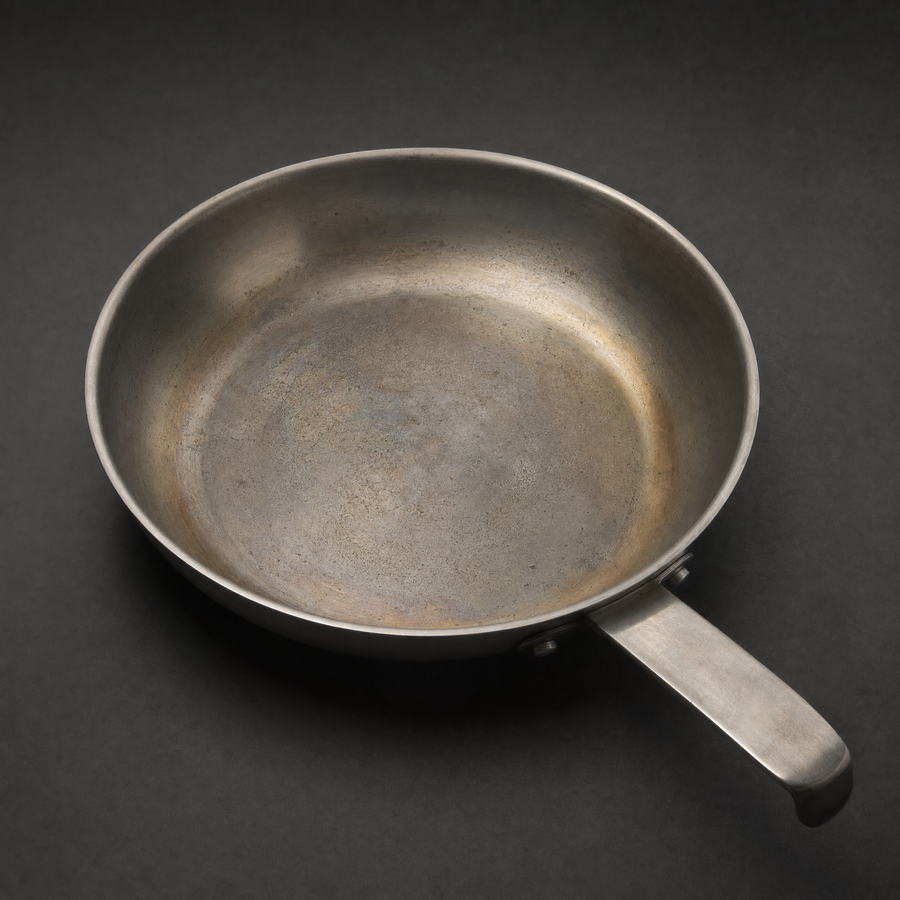
Ours has no coating. Not a better coating, not a titanium-enriched coating. None. There is nothing between the metal and your food, which is why there is nothing to scratch off into it.
Including the two rows where non-stick still wins. A table where one column sweeps every line is an advertisement, not a comparison.
| Criterion |
 OursSolid titanium OursSolid titanium
|
 PTFE nonstick PTFE nonstick
|
 Bare stainless Bare stainless
|
|---|---|---|---|
| Body | Solid titanium | Aluminium | Stainless steel |
| Cooking surface | Bare titanium | PTFE plastic film | Bare steel |
| Coating | None at all | The whole product | None |
| PTFE, PFOA, PFAS | None | Present | None |
| Replace every | Never | 2 to 3 years | Never |
| Weight vs stainless | About half | Light | Heavy |
| Metal utensils | Yes | No | Yes |
| Food release | Good, with a little oil | Best, needs none | Hardest |
| Needs preheating | Yes | No | Yes |
| Reacts with acid | Never, inert | No | Can pit |
| Metallic taste | None | None | Possible |
| Flakes into food | Nothing to flake | Once worn, yes | No |
Replacement intervals are typical manufacturer guidance for coated pans and vary with use.
No edits that hide the technique. Preheated pan, thin film of oil, then the food.
In use
Our own pan, our own kitchen, no stock photography and no styling that hides the technique.


0
Nothing sits between the metal and your food. No film to scratch through, so no point at which the pan is used up.

50%
Titanium carries comparable strength at roughly half the mass. You feel it the first time you lift it one handed.

1
Non-stick is a consumable you re-buy every few years. Bare metal has no equivalent failure point.

Inert
No rust, no corrosion, no metallic taste. Tomato, wine, lemon and salt do not touch it.
The specification, in full
Published in full, because in this category the specification is the product. Ask any brand selling a titanium pan for these six lines and watch what happens.
Body material
Solid titanium
Commercially pure titanium throughout. Not an alloy, not a plating, not a coating over something cheaper.
Cooking surface
Bare metal
The same titanium as the body, hammered into a honeycomb texture that aids release. Nothing is applied on top.
PTFE, PFOA, PFAS
None
There is no coating in which such chemicals could exist. This is a structural fact about the pan, not a treatment choice.
Diameter
28 cm
Roughly 11 inches. Four eggs or two large steaks without crowding.
Compatible hobs
All four
Gas, electric, ceramic and induction.
Care
Dishwasher safe
Metal utensils are fine. Heat discolouration is an oxide layer and is harmless.
Mill certification and independent laboratory results are held on file and published here rather than summarised.
Before you buy
Bare titanium releases food when it is hot and lightly oiled. It behaves like the best stainless you have used, not like a plastic coating. Hot pan, thin film of oil, then the food.

We could leave this out and sell a few more pans this week, then see them come back next month. If you want food to release from a cold dry pan with no technique, buy a coated one and replace it in two years. That is a real trade and some people should take it.
Cook on it properly for three months. If it has not become the pan you reach for first, send it back and we refund you, including what it costs to return it. Used pans are fine. A pan you kept in the box is not a test.
A coated pan is replaced every two to three years. Price this against the four you would otherwise buy, not against the one on the supermarket shelf.
What arrives
 The pan28cm, solid titanium
 The lidTempered glass, 28cm
Free shipping in the United States. Ninety day guarantee, used pans accepted, return postage covered.
Questions
Yes. Body and cooking surface are the same solid titanium, with nothing applied over it. Ask any other brand selling a titanium pan whether the pan is titanium or the coating is. The answer is usually the coating.
It releases food cleanly with a thin film of oil in a properly heated pan. It is not a plastic coating pretending to be metal, so it does ask for a hot pan and a little fat. Three steps are above.
No. There is no coating on this pan, so there is nothing those chemicals could be in. That is a fact about how it is made rather than a promise about what was left out.
Gas, electric, ceramic and induction. Check the specification above for the induction base detail before ordering.
Yes. There is no coating to cut through, which is the whole point. Scratches are cosmetic and change nothing about how it cooks.
Yes. Titanium does not corrode, so detergent does nothing to it.
No. Titanium develops a bronze or blue tint where it has been heated. It is an oxide layer, it is inert, and most owners come to like it.
Compare it to the right thing. One coated pan is cheaper. The four you would buy over the next eight years are not.
Ninety days. Cook on it properly and send it back if it does not become the pan you reach for. We pay the return postage and we accept used pans. The lifetime warranty covers defects for as long as you own it.
Before you go further
Pick the one that matters to you and we will send that answer, plus the buying guide we wrote for people comparing titanium pans.
One email with the answer and the guide. Unsubscribe in one click.